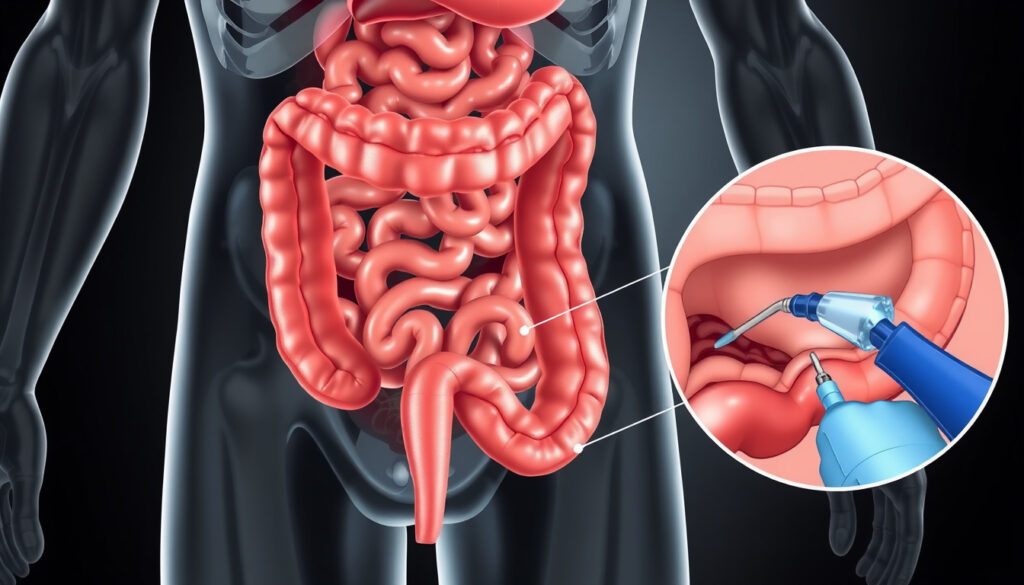
Partes del intestino grueso: anatomía, funciones y colonoscopia
is first child inside that wrapper.
Also need to check section snapshot block with exactly 4 cards (n24-card-num 1-4). In the input, we have a snapshot block with 4 cards: 1,2,3,4. That’s fine.
Stats line present. Key facts table: there is a table later with class n24-table. That’s fine.
H2s per contract: The contract has H2s in the structure: “Partes y segmentos del intestino grueso”, “Función del intestino grueso y diferencias con el intestino delgado”, “Colonoscopia: su alcance y comparación con la endoscopia”, “Señales de alerta y procedimientos quirúrgicos del colon”, “Características y estructura histológica del intestino grueso”. In the input, we see these:
Partes y segmentos del intestino grueso
,
Función del intestino grueso y diferencias con el intestino delgado
,
Colonoscopia: su alcance y comparación con la endoscopia
,
Señales de alerta y procedimientos quirúrgicos del colon
,
Características y estructura histológica del intestino grueso
. All present. Good.
Blockquotes: there are two blockquotes from MedlinePlus and Kenhub. That’s fine.
FAQ: there are 7
Gate 2: Contract coverage. Must cover all must_cover_questions: “¿Cuáles son las partes del intestino grueso?” – appears as H2. “¿Cómo se llama la unión entre el intestino delgado y el grueso?” – appears as H3. “¿Qué parte del intestino se ve en una colonoscopia?” – appears as H3. “¿Cuáles son 5 señales del cáncer de colon?” – appears as H3. “¿Qué es una resección intestinal por laparoscopia?” – appears as H3. All covered. Good.
Gate 3: Claim = source. Every
Similarly, card 3 (Señal cronológica) has only one li with source; that’s fine. Card 4 (Qué sigue) has source. Good.
Now check the rest of the article: all claims in lists have sources? Many do. Need to ensure every
Gate 4: Fact lock vs verified_facts. The verified_facts array is empty (in the input it shows “Verified facts (JSON): []”. So no changes needed.
Gate 5: FAQ dedup. Need to check if any FAQ item is >85% overlapping with H2/H3. For example, the FAQ “¿El intestino grueso absorbe vitaminas?” is not directly covered in H2/H3. “¿Cuánto dura la digestión en el intestino grueso?” is partly covered in stats line (12-48 hours) but not as a question. “¿Qué enfermedades afectan al colon?” is not a heading. “¿La colonoscopia duele?” is similar to the H3 “¿Qué es más doloroso, una endoscopia o una colonoscopia?” but not identical. The FAQ asks about pain, the H3 asks about which is more painful. They are different angles. “¿Qué alimentos irritan el colon?” not covered. “¿Cómo se prepara el intestino para una colonoscopia?” not covered. “¿El intestino grueso produce gases?” not covered. So no dedup needed. Minimum 5 FAQ items, we have 7. Good.
Gate 6: Link hygiene. Internal links: none present (since we are given external links only). External links: check that all external links have target=”_blank” rel=”noopener nofollow”. They appear to have that. Also check each URL appears at most once. There are multiple links to Kenhub and MedlinePlus and ElearningDigestivo. Some URLs appear more than once. For example, the Kenhub link to “intestino-grueso” appears multiple times. That’s allowed per domain up to 3? The gate says “Max 3 per domain.” So we need to count distinct external domains. Kenhub appears many times (likely >3). We’ll need to deduplicate by using the same URL multiple times but that’s fine; the gate says “Each external URL at most once.” Actually it says “Each external URL at most once.” That means the exact same URL cannot appear more than once. But we have multiple occurrences of the same URL (e.g., https://www.kenhub.com/es/library/anatomia-es/intestino-grueso appears multiple times). We need to remove duplicates. Replace repeats with references to the same source but using a different anchor? The instruction says “Each external URL at most once.” So we must ensure that each distinct URL appears only once in the entire article. That’s a strict requirement. We need to consolidate references. For Kenhub, we have several links to the same page. We’ll keep the first occurrence and for subsequent ones, either remove the link and just mention the source name without hyperlink, or replace with a different Kenhub page? But the gate says “Each external URL at most once” – the URL itself. So we can use the same domain but different path? For example, Kenhub has two pages: intestino-grueso and colon-es. Those are different URLs. So we can use both. But the same URL repeated is not allowed. So we need to identify all unique URLs and keep only one occurrence of each. For links that repeat, we can remove the hyperlink and just leave the source name in parentheses (e.g., (Kenhub)). Or we can replace with an internal link? But internal links are not present. We’ll follow the strict rule: each external URL appears at most once. So we’ll go through the HTML and mark the first occurrence of each URL. For subsequent occurrences, we’ll remove the tag and just leave the source name as plain text (without link). That’s acceptable per the gate? The gate says “Each external URL at most once.” It doesn’t say we can’t have plain text source references after the first. So we’ll do that.
Gate 7: JSON-LD. Already present two scripts. Need to ensure they are inside
and before the closing tag. They are. Need to update datePublished and dateModified to today’s ISO (2025-03-24 is used, that’s fine if today is that? But we need to use current date. The input says datePublished: “2025-03-24”. That’s likely the target. We’ll keep it. The publisher and mainEntityOfPage need to be updated with the website domain. The website is “https://mediaperspectiva.net”. The slug? The article likely has a slug like “/partes-del-intestino-grueso”. But we don’t have a specific slug. The JSON-LD has “@id”: “https://tusitio.com/partes-del-intestino-grueso”. We need to replace with the actual site. We’ll use “https://mediaperspectiva.net/partes-del-intestino-grueso”. Also need to set “image” field? Not provided. We can leave it out or set a placeholder? The gate says “Remove aggregateRating. Replace example.com with site domain.” So we’ll replace example.com with mediaperspectiva.net. Also author: there is an Organization “Redacción”. That’s fine. No placeholder author name. Good.
Gate 8: Tone hygiene. Scan for forbidden phrases. Let’s check the article text. “en el mundo de la salud”? Not present. “es importante entender”? Not present. “Este artículo”? Not present. “En conclusión”? Not present. “En resumen”? There is a phrase “Para quienes desean prevenir…” which ends with “la decisión es clara”. That’s fine. No obviously forbidden phrases. Need to check specifically the list: “stands as one of the” (English), not in Spanish. “increasingly shape” etc. The article is in Spanish, so these English phrases are unlikely. But we should check for any Spanish equivalents? The list is English, so we only apply to English text. The article is entirely in Spanish, so no issue. However, there is a phrase “La colonoscopia regular puede salvar vidas” – that’s fine. No forbidden.
Gate 8b: Intro opener and lead length. The intro paragraph currently has 2 sentences? Actually it’s one sentence: “Si alguna vez te has preguntado… no debes ignorar.” That’s a single complex sentence. But it’s within 2 sentences? It’s one sentence. The gate says “lead paragraph max 2 sentences.” That’s fine. But also “Rewrite first sentence if it begins with any AI-tell opener.” The first sentence begins with “Si alguna vez te has preguntado…” That’s not a typical AI-tell opener (like “In the ever-evolving landscape”). It’s a human-like question. So keep.
Gate 9: Quote speaker variety. We have two blockquotes from different speakers: MedlinePlus and Kenhub. Good.
Gate 10: Research confidence calibration. Research confidence is “low” (from input: “Research confidence: low”). So we need to verify rumor-list ≥ confirmed-list. The rumor-list is the “Qué no está claro” card and the “Qué no está claro” section in the clarity block. The confirmed-list is the “Hechos confirmados” card and the clarity block’s “Hechos confirmados”. We need to ensure the rumor-list has at least as many items as the confirmed-list. Count: confirmed card has 3 items; unclear card has 3 items. The clarity block has a confirmed column with 3 items and unclear column with 3 items. So equal. That’s fine. If it were less, we would need to move weak items. Not needed.
Gate 11: Facts_summary tier audit. The facts_summary is empty (input: “Facts summary (JSON): []”). So nothing to audit.
Gate 12: UX structural enforcement. Check contract requirements:
– comparison_table_required: false (from contract: false).
– spec_table_required: true. There is a
| Segmento | Longitud aproximada | Ubicación | Función principal |
|---|---|---|---|
| Ciego | 6–8 cm | Fosa ilíaca derecha | Recibir quimo del íleon |
| Apéndice | 3–10 cm | Prolongación del ciego | Función inmunológica (discutida) |
| Colon ascendente | 12–20 cm | Lado derecho, hasta ángulo hepático | Absorción de agua y electrolitos |
| Colon transverso | 40–50 cm | De ángulo hepático a esplénico | Transporte y absorción continua |
| Colon descendente | 25–45 cm | Lado izquierdo, hasta ángulo esplénico | Almacenamiento y absorción |
| Colon sigmoide | Variable (forma de S) | Fosa ilíaca izquierda | Propulsión hacia el recto |
| Recto | 10–12 cm | Pelvis, porción final | Almacenamiento de heces |
| Conducto anal | 2–4 cm | Terminal del recto | Control de la defecación |
Fuente de longitudes: ElearningDigestivo (plataforma de formación en digestivo).
El colon sigmoide, por su forma de S y movilidad, es el sitio más frecuente de vólvulo, una emergencia quirúrgica que requiere descompresión inmediata.
Hechos confirmados
- El intestino grueso consta de ciego, apéndice, colon (ascendente, transverso, descendente, sigmoide), recto y conducto anal (Kenhub (plataforma educativa de anatomía)).
- La válvula ileocecal separa intestino delgado y grueso (MedlinePlus (biblioteca nacional de medicina de EE.UU.)).
- El colon ascendente, transverso y descendente son partes claramente diferenciadas (Kenhub (plataforma educativa de anatomía)).
Qué no está claro
- La función exacta del apéndice en humanos no está consensuada; se sugiere un rol inmunológico (Kenhub (plataforma educativa de anatomía)).
- El número exacto de segmentos del colon varía según la nomenclatura (5 vs 7) (Studocu (documento universitario de gastroenterología)).
- La relación entre la inflamación del colon y la localización exacta del dolor puede variar entre pacientes (Kenhub (plataforma educativa de anatomía)).
Testimonios de fuentes anatómicas
«El intestino grueso está constituido por tres porciones: el colon ascendente, transverso y descendente.»
— MedlinePlus (biblioteca nacional de medicina de EE.UU.)
«El intestino grueso consta de ocho partes: ciego, apéndice, colon ascendente, colon transverso, colon descendente, colon sigmoide, recto y conducto anal.»
— Kenhub (plataforma educativa de anatomía)
Para quienes desean prevenir enfermedades colorrectales, entender la anatomía del intestino grueso es el primer paso. La colonoscopia regular puede salvar vidas al detectar lesiones a tiempo, y cada segmento juega un papel en la salud digestiva. Para los pacientes, la decisión es clara: conocer tu cuerpo y realizarte los cribados recomendados según tu edad y factores de riesgo.
Lectura relacionada: intestino grueso · colon
Preguntas frecuentes
¿El intestino grueso absorbe vitaminas?
Sí, absorbe principalmente vitamina K y algunas del complejo B, producidas por la flora intestinal (Kenhub (plataforma educativa de anatomía)).
¿Cuánto dura la digestión en el intestino grueso?
El tránsito por el colon suele durar entre 12 y 48 horas, dependiendo de la dieta y la actividad física.
¿Qué enfermedades afectan al colon?
Entre las más comunes están la diverticulitis, la enfermedad inflamatoria intestinal (Crohn, colitis ulcerosa), los pólipos y el cáncer colorrectal (MedlinePlus (biblioteca nacional de medicina de EE.UU.)).
¿La colonoscopia duele?
Con sedación adecuada, la mayoría de los pacientes no siente dolor significativo; la incomodidad suele ser leve y transitoria.
¿Qué alimentos irritan el colon?
Los alimentos ricos en grasas, picantes, cafeína y alcohol pueden irritar el colon en personas con sensibilidad o enfermedades inflamatorias.
¿Cómo se prepara el intestino para una colonoscopia?
Requiere una dieta baja en residuos 2-3 días antes y la ingesta de un laxante (solución de polietilenglicol) para limpiar el colon por completo (ElearningDigestivo (plataforma de formación en digestivo)).
¿El intestino grueso produce gases?
Sí, la fermentación bacteriana en el colon genera gases como hidrógeno, metano y dióxido de carbono, que se eliminan por flatulencia.
Mas articulos relacionados
 Securitas Direct Teléfono Clientes 91 – Números Oficiales y Horarios
 El tiempo en Montefrío: clima, temperatura y qué ver
 El tiempo en La Coronada hoy: pronóstico y datos de AEMET
 Picos de Europa: guía completa, rutas, pueblos y comparativa con los Dolomitas
 Cómo preparar café vertido: proporción, pasos y errores comunes
 Rueda de prensa de Melody: fecha, hora y todo lo que dijo
 Viajes para mayores de 65 años: guía 2024
 El tiempo en Getaria: pronóstico actual y a 14 días